Xu Xi: Kickbacks
The acclaimed Hong Kong born and raised author asks, “To witness death at a distance, while you are safe as houses, how do you grieve?"
By Xu Xi
Home is where you kick back, remove uncomfortable shoes and clothes from your outdoor self and retreat into that safest space. It doesn’t matter if, as usual, A is grumpy in the kitchen, B is hungry, C is glued to the cellphone and D is late for dinner. It’s home, where everything is how it should be, and where you can be your most authentic self. As safe as houses, Victorian English for the space that is home.
Until everything comes tumbling down.
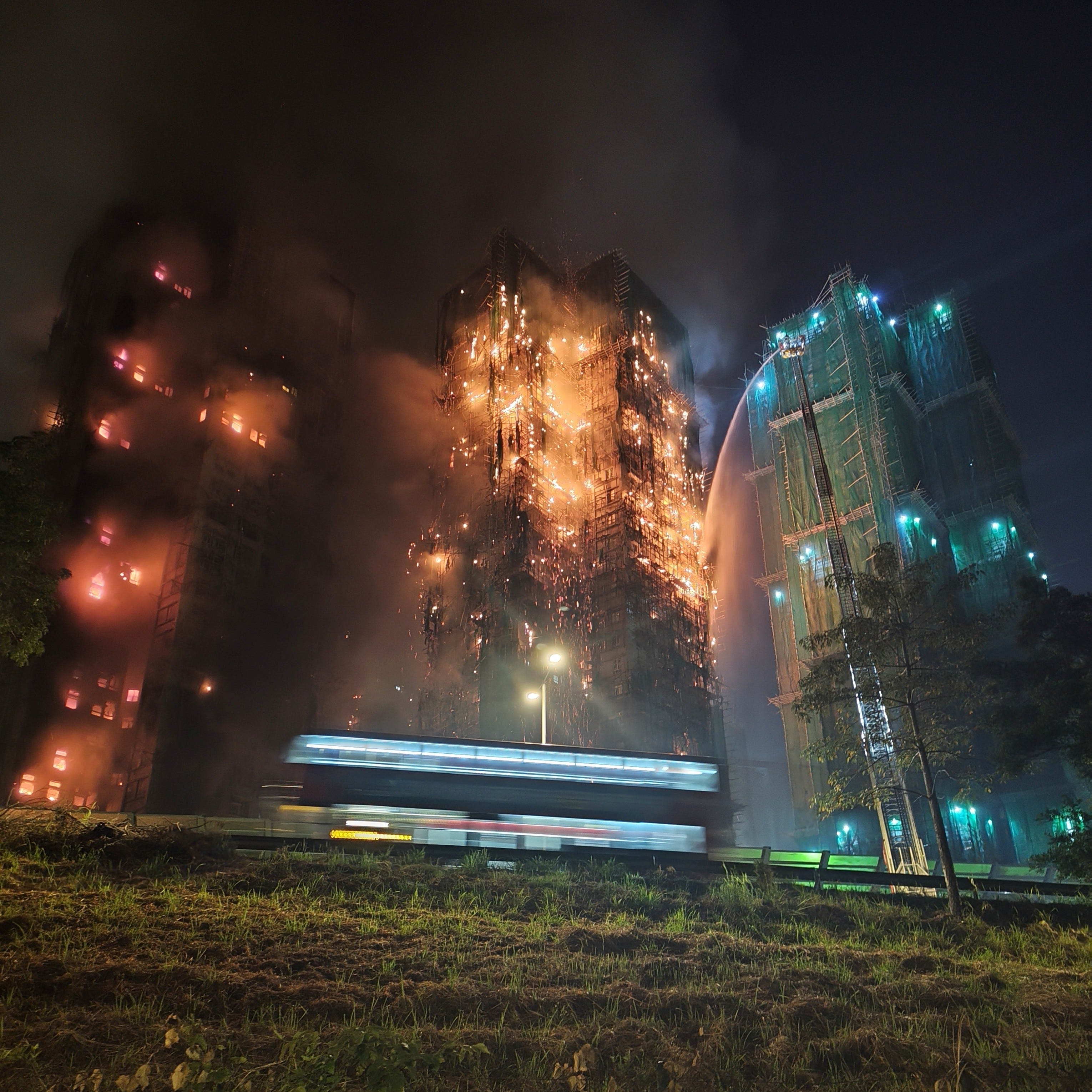
Investigations into Hong Kong’s most massive fire in a dog’s age—the once towering now blackened Wang Fuk Court apartment complex in Tai Po burned for nearly 48 hours, killing 161 Hong Kongers and injuring 79 just two months ago—are not reassuring. Bid-rigging bigwigs paid kickbacks in Shenzhen sauna, says construction veteran “Raphael Chan” in one post-blaze headline. The name is fictional, changed at his request, the fear palpable. Everyone knows the construction industry the world over is rife with corruption. Corners are cut, bullying is corrosive, and the profit-lust conspicuous. In some nations such tactics even propels one to palatial presidential spaces where kickbacks are mega-wiggishly lucrative, as opposed to merely bigwiggishly so. But this reflection is not about outsized egos or those who would be king. The rest of us just want home spaces that feel safe and sound without the sky falling.
Unless you too, like Henny Penny are sadly misled and lured into the fox’s den where you’re dead meat.
∞ ∞ ∞
Unless you’re a billionaire who can afford a detached house or luxury flat, in Hong Kong, home is a public or private flat, with an average size somewhere between 300 to 600 square feet. The latest government estimates of average living space per person is between 215 to 237 square feet, but everyone knows many do with far less. You don’t swing cats indoors but it’s still home, until it’s not.
As a result, many Hongkongers must succumb to the renovation roller coaster. We did, back in 2017, when Mum was already mostly lost to Alzheimer’s and wheelchair bound in our family home, which was also my Hong Kong address because one of us had to live there in order to hire helpers and manage Mum’s care. We were lucky because our building management committee was not particularly corrupt, unlike the Wang Fuk Court committee, around whom allegations abound. Even so, original construction back in 1970 was of such poor quality that we long ago accepted the lack of building authority oversight in the era pre-ICAC (Independent Commission Against Corruption), a condition that saddled us with this white elephant of a building that has never, ever worked quite right. However, we had a large, an enormous space, almost 1,200 square feet for a family of six, a space that emptied out over the years as four children spread our wings and left the nest, this home to which we could always return until we couldn’t. Dad had built a rooftop guest room of our top floor flat, which I then inhabited, as illegal structures to expand living space were also a given, even in the post-ICAC era. Such rooftop construction, alongside extended verandah enclosures and other unauthorized building structures normalized into the city’s landscape well into the 21st century. Dad had died unexpectedly in 1998 of an aneurysm, and for the next 20 years until after my mother’s demise, that flat became Mum’s home to where we always came to roost.
Our 2017 renovation was a major upgrade, to enlarge inadequate drainage, replace the two odd and even floor lifts that constantly broke down, repaint the exterior, improve structural integrity. Etc. Etc. Scaffolding, sheaths of green netting, perpetual dust. Workers climbed onto our rooftop one morning without warning, startling me, because I occupied the approximately 110 square foot roof room. We succumbed to the upgrade, because what else can you do? Home improvement is an ordeal, but your sights are trained on a better tomorrow.
Unfortunately, some tomorrows never come.
An impossible grief, witnessing the horrific Tai Po fire virtually from my rural home in Northern New York as the Thanksgiving holiday approached. My husband and I were both ill and missing Thanksgiving at my sister-in-law’s home in Virginia. The fire propelled me backwards in time — to Covid and the city’s restrictive quarantine policies that prevented me from returning to Hong Kong for five years; to 2019 and the Polytechnic University occupation, my last time in the city before Covid, during which it was only possible to watch the protests from a distance and not cross the harbor to Kowloon; to 2003 when SARS shut down the city which was when I accepted a travel writing assignment and flew to Hainan instead. To witness death at a distance, while you are safe as houses, how do you grieve? All I could do was watch, horrified, fearful for all those strangers who had lost everything we call home. Their renovation mess was bad enough, but this inferno? No words suffice to comprehend what increasingly appears to have been a preventable situation.
Back in my own past, we endured the renovation mess, grateful we could still take Mum out for her morning walk in the park next door. She was mostly wheelchair bound because three years prior, she had fallen and broken her hip and required surgery. Although she recovered some mobility in post-op physical therapy, it was difficult for her to walk without assistance. Once she came home from the hospital, we brought her to the park every morning where she walked as many rounds of the perimeter as she could, with one of us holding onto her. It became part of her daily routine, and by 2017, at the age of 97, Mum still could do this. The wheelchair was helpful for taking her out to the nearby shopping mall, where she could walk around and window shop and for my Hong Kong-based sister to drive us somewhere for lunch.
The fire took away all the victims’ daily routines, whether it meant going to work or school, shopping at the market, going to the park for their morning tai chi, meeting family and friends for yum cha or dinner. In particular, the many seniors who lived in the complex — some as empty nesters, some with just a domestic helper, some who, like my mother, may have had a disability —horrifying to think that for the elderly or disabled, the dead might be better off than the living who must survive without home.
Initially, our building renovation went well, and despite all our complaints, we knew it would eventually be over. Ours was a small building, two wings on 12 floors, six flats to a floor, a much less complex job than at Wang Fuk Court. Ours was a small construction contract, but you would think that such a large renovation as the Tai Po complex meant a hugely lucrative enough contract to pay contractors and subcontractors well to do a proper job, meeting safety requirements and construction standards. You would think.
Instead, the victims must now confront the loss of the meaning of home.
Meanwhile, back in our own renovation, the odd-floor lift had been upgraded. It was now our turn to have the even-floor lift fixed, a job that could take, we were told, at least a month or longer. Which meant Mum was stuck at home. She could not climb stairs from 11 to 12, and to lift her in her wheelchair and risk dropping her? No, we just couldn’t do that. We’d only walk her around the flat, to try to maintain a daily schedule. This was temporary, we reasoned and she would be fine. After all, Mum was still at home and not in some elder facility, something we considered but could not do to her, something she would have hated. Our mother was so proud of this flat we called home for so long: this relatively inexpensive flat she finagled to buy after my father’s bankruptcy, over Dad’s objections, in order to rent out our much more expensive city flat for income; this flat that was, back in 1970, not highly desirable, but held and increased its value over time; this flat she left as a legacy to us, her children, who knew Mum kept family, house and home together when Dad, broke and depressed, could not. Our helpers still could cook the meals she liked, she could still sleep in her own bed, we could bring over takeout from restaurants since she couldn’t go out. That would be OK, at least she was still at home. You would think.
We took her for a regular doctor’s visit right before our lift was finally shut off for renovation, and we were still able to get her up to 12 to home. She was pronounced healthy and well and likely to live for a long, long while. Great, we thought. Yet a week or so later, Mum died. She was old, hearts congenitally fail. However, we often wonder if she simply lost her sense of home, the space where she was still “independent,” despite Alzheimer’s, because she was trapped, unable to maintain any kind of daily routine that felt like home. For years, she clung onto life, well past all her contemporaries, including all her younger siblings and other relatives. Even though her memory long ago vanished, something about life at home evoked a need for her to keep going. She often said, I still have so much to do. In moments of lucidity, she would ask us, no, insist we get this or that done. Some nights, she talked aloud to dead people, even though her daylight hours were silent. Perhaps she was telling them, my family still needs me, there’s reason to live, it’s not yet time to join you.
I was clutching Mum’s hand, begging her to hold on just a little longer the moment she died, nanoseconds before the paramedics arrived. They pushed me aside, gave her oxygen, pumped, pumped, pumped. But I knew it was too late, having heard the death rattle as they rushed into our home. She was officially pronounced dead about three hours later at the hospital to where the ambulance brought us. Just like that, home was no longer home.
Now, eight years after Mum’s demise, and nearly two months after the terrible Hong Kong fire, the idea of home has become that idea of order, overturned. The true horror of this tragedy is that no one listened to the residents who complained about shoddy materials and questionable practices, that alarms did not sound as they should have, that this enormous contract to renovate an entire estate was possibly squandered and raided by corrupt practices, and now, thousands have lost their homes. Were there kickbacks? With time, we hope an investigation will uncover some truths. But nothing will mitigate this unnecessary disaster, this collapse of order for proper construction practice, this deterioration of memory of how things can and should be done, of how homes ought to be built to house our city’s people, because everyone needs a space that feels like home. Everyone.
Hongkongers have great longevity, and for those of us who remember the establishment of the ICAC, and the improvement of building standards after fires, landslides, typhoons upended earlier constructions, we can only ask, is the city suffering from Alzheimer’s? Have we forgotten how to prevent corruption, maintain standards, listen to citizens when they raise concerns? Recently in the news, there was a story about one 40-year-old social worker trying to raise her two young children and mother-in-law alone, because her husband died in the fire and she is now the sole provider. She’s finally rented a new flat, and with the help of friends and donations, she is slowly rebuilding a sense of home. They miss their daddy, she says, and when her children ask why God doesn’t listen to their prayers, she comforts them by saying that their father left without suffering from pain, he just lost consciousness.
What is the reason to live? At least my mother had a modicum of a choice, and perhaps, when home became truly unrecognizable, she finally just gave up the ghost.
XU XI 許素細 www.xuxiwriter.com has published 15 books including novels and collections of short fiction and essays and edited five anthologies, including a co-authored textbook The Art and Craft of Asian Stories: a writer’s guide and anthology (Bloomsbury, 2022). A fiction collection, Horizon Hong Kong: Selected Stories, will be released by Gaudy Boy Press, New York in July, 2026; her novel-in-manuscript The Milton Man was a 2024 finalist for Fiction Collective 2’s Catherine Doctorow prize. Until 2025, she held the Jenks Chair in Contemporary American Letters at the College of the Holy Cross, Massachusetts where she taught creative writing; previously, she was writer-in-residence at the City University of Hong Kong where she founded and led the first Asian low-residency MFA after which she co-led an International MFA in writing and literary translation at Vermont College of Fine Arts where she was a faculty chair at their low-residency MFA and on their prose faculty for many years. Additionally, she taught at and was distinguished writer-in-residence at the University of Iowa’s Nonfiction MFA, the Virginia G Piper Center for Creative Writing at Arizona State University and the distinguished Asian writer at the Philippines National Writing Workshops at Silliman University in Dumaguete. Prior to teaching, she had an 18-year career in international marketing and management for major corporations and businesses in New York and Asia, including at Cathay Pacific Airways, Pinkerton’s, the Wall Street law firm Milbank Tweed, Federal Express and Dow Jones’ Asian Wall Street Journal, among others. She continues to offer writing workshops internationally and recently served as a theses advisor for the MA in creative writing at La Salle College of the Arts in Singapore where she was their 2025 visiting writer-in-residence.


TFP is honored to have Xu Xi, the acclaimed author of 15 genre-bending books including novels, essays, short stories, and memoir, as our first guest essayist for 2026. “The elegance of her language is breath-taking,” says novelist Kim Echlin. Read this moving essay about caring for her elderly mother and the recent devastating Hong Kong apartment complex fire and you’ll agree.
My dear Xuxi,
I was immensely touched by the way your lament carries a slow, accumulating grief that keeps circling one idea: when home ceases to be a refuge, something essential in a life comes undone. It braids a public catastrophe—the Tai Po fire—with a private loss, your dearest mother, until individual apartment, aging body, and burned tower feel like versions of the same fragile structure. The sorrow you express is not the clean kind; it is tangled with anger at corruption, negligence, and institutional amnesia, and with the sick knowledge that the disaster was likely preventable.
Tenderness and fury circle back and forth. Your mother’s small routines, her stubborn will to “still have so much to do,” and the cramped rituals of Hong Kong flat life are rendered with so much affection, which makes their erasure feel brutal rather than abstract. Your apt metaphor of Alzheimer’s extends from your mother to the city itself—a place that once learned hard lessons about corruption and building standards, now seemingly forgetting them.
What lingers is a helpless, indicting question: if home is where meaning and routine reside, what happens to people, especially the vulnerable, when both are casually destroyed?
And more profoundly, can you kick back when there are kick-backs?