Diary of War and Justice in Ukraine
A conversation with Ukrainian writer Victoria Amelina about her new project, “War and Justice Diary: Looking at Women Looking at War,” and holding Russia accountable for its murderous war crimes.
By Michael Judge
Earlier this month—while writers elsewhere were vacationing, giving readings, or attending festivals—Ukrainian writer Victoria Amelina was traveling to the war-torn cities of Kharkiv and Kryvyi Rih to document the work of the brave Ukrainians recording Russian war crimes there.
Amelina, 36, is widely seen as a key figure in the future of Ukraine’s rich literary tradition. An award-winning author of essays, novels and children’s literature, she’s best known for her two novels, Fall Syndrome (2014) and Dom’s Dream Kingdom (2017), which, widely translated, earned her the Joseph Conrad Literary Award, and made her a finalist for the European Union Prize for Literature.
The working title of her latest project is War and Justice Diary: Looking at Women Looking at War, a nonfiction book that follows the paths of journalists, human-rights activists, lawyers, and volunteers who document Russian war crimes in Ukraine. Those crimes, as anyone paying attention knows, include the bombing of hospitals, schools, universities, museums, libraries; and the use of rape, torture, murder and kidnapping (including of children) as weapons of war.
The book will also clarify why it’s crucial to hold Russian forces accountable for their war crimes now, even as the fighting continues. Collecting evidence and documenting crimes now not only lays the groundwork for justice when the war is over; it also lays the groundwork for victory by forcing the world to see this war for what it is—the frontline of a larger war between democracy and autocracy; impunity and justice. For, as Amelina said recently in a reading, “Evil that goes unpunished, of course, grows and comes back to kill us with more strength.”
When I spoke to her from her home in Kyiv it was a Monday morning, two days before Ukraine’s Aug. 24 Independence Day. Air-raid sirens began wailing in the background. “The Russians are especially angry with us right now,” she said. When I asked if she needed to go to a safe place, she replied, “I’m OK,” hardly missing a beat, as she moved into the hallway, away from glass windows, and continued explaining why the world must hold Russia accountable for its war crimes now, while the war still rages; and after, when Ukraine is victorious.
MJ: I just wanted to start by saying thank you so much for finding the time to do this. I’m sorry it’s taken so long to get in touch with you. We’ve been trying to connect with each other for a few weeks, and you’ve been traveling, I think, first to Kharkiv, and then you went to the south, near Kryvyi Rih, I believe…
VA: Kryvyi Rih, yeah. Right.
MJ: How did your work in those places go, and what did you see there, and what did you learn there?
VA: So, I basically went to Kharkiv and to the south to also interview people for different reasons. In Kharkiv, I actually almost had a small writer’s residence, because in the peaceful times, we had a wonderful writers’ residence there in the Slovo Building, which is an apartment building, built in the 1920s, for the most talented Ukrainian writers. The Ukrainian capital was in Kharkiv back then in the times of the Ukrainian USSR. So it was a very important place for culture, theater, and literature. The Slovo Building is where all those Ukrainian writers lived. Then, in the 1930s, one by one, they were arrested, and mostly executed. More than 85% of them, I guess, so it’s hard to count, but the majority of Ukrainian intellectual life was executed in the 1930s. So, in recent years, a writers’ residency was established in this very building.
VA: Now, it’s an ordinary building. But we have one apartment dedicated to the residency. Right now, the residency is stopped, because the city has been heavily shelled almost every day and every night. But I wanted to go there to talk to people who are involved in documenting war crimes in various ways. I think my most important meeting there was with a lawyer who stopped fighting for justice in the courtroom to become a soldier in the Ukrainian Army. So, we met and talked about her choice. I also talked to the director of the Kharkiv Literary Museum, Tetyana Pylyptshuk. Fortunately, her museum is OK so far. But she’s helped to document the destruction in other museums in the Kharkiv region, and in other facilities, like destroyed universities, et cetera. She’s collecting things for a future museum of the Russian-Ukrainian war. So we talked about that and I explored what they have there.
Also, I went to the recently destroyed Hryhorii Skovoroda Museum. Skovoroda was a prominent Ukrainian philosopher, a very important figure in Ukrainian culture. The museum is actually located amidst a wonderful landscaped park, so it’s not near any military targets; it’s very secluded. Still, Russian missiles directly hit the museum, specifically destroying the building where Skovoroda spent some years. So, it’s a historic building and it is now lost. That’s a huge loss for the nation and those who worked there. They’ve received a lot of attention recently, but I wanted to talk directly to the director of the museum about this particular war crime. She knows what was lost, she’s on the scene.
As for the south, I was traveling with one of the NGOs that is documenting war crimes there. We interviewed people who managed to escape the occupied villages of the Kherson region. These interviews were not for the media, but for future justice. Basically, those records will be given to the general prosecutor’s office, and there’s a chance that they will help to prosecute the perpetrators.
MJ: Back in March, in Eurozine magazine, you wrote about the war on Ukrainian culture, saying “There’s a real threat that Russians will successfully execute another generation of Ukrainian culture,” I think a lot of …
VA: Well, that was my feeling in March. Right now it looks like they won’t succeed, but in March that was my great fear.
MJ: But many people in the U.S., I think, and in the West, don’t understand what took place in the 1930s, what Ukrainians call the “Executed Renaissance,” and how that is something that Putin seems determined to do again. So I think it’s very important how you’ve drawn a parallel between now and what happened in the ’30s, and this intention to wipe out not just Ukrainian resistance, but Ukrainian culture and Ukrainian writers, and, in fact, the Ukrainian language.
VA: This is actually one of the crucial goals of the Russian regime. Putin, infamously, has said this—that Russians and Ukrainians are “one people.” This is what he claims. And this is one of the reasons they would always say, if you have a culture, show it to us, even as they were executing Ukrainian intellectuals. “We have great Russian culture, what do you have?” While they were responsible for wiping much of it out. They didn’t even start in the 20th century; they started long before. Our main poet, Taras Shevchenko [1814–1861], spent years in the Russian Army being punished, and it was forbidden for him to write or draw. So, this was a method of punishment for him for writing in Ukrainian, and for representing the Ukrainians as a separate people.
So, this was happening all the time. Then, in the 1930s, with the “Executed Renaissance,” Russia literally executed an entire generation of very talented Ukrainian avant-garde writers. This was the culmination of something that was going on for decades, but it didn’t stop there. The 1980s, for instance, were relatively good years for Russian writers. Some freedoms, like Glasnost, had come. But for Ukraine it wasn’t like that. For example, my favorite poet, the very famous Ukrainian poet, Vasyl Stus, was murdered in a Russian camp in 1985. There were many arrests in the ’70s and ’80s in Ukraine. This fight never stopped for Ukrainians.
“Even now, I’m not sure we will be able to break the circle of Russian impunity. If I was certain that this was going to happen, I would go to my little son who stays in Poland, and just wait until it happens without me. But it is still unclear if, finally, the evil will be punished.”
Sadly, there were always more freedoms in Moscow than in Kyiv, because they also had to suppress any national thought in Ukraine, and everything that could lead us to view ourselves as not just part of the great Russian people. Some folk art was permitted—folk dance, folk songs—but it was misrepresented. We, of course, had our philosophers, our writers, our contemporary artists. This is what’s very important for our Ukrainian identity, and what’s now being targeted. For example, in Mariupol, there were mosaics by the famous Ukrainian artist Alla Horska. In 1970 she was murdered by the Soviet regime, and last month Russian forces destroyed her beautiful, human mosaics in Mariupol… along with the entire city. Now, they will ask again, “Where is your art?” Well, you destroyed it.
MJ: You recently quoted on Twitter a piece by Alexander Khara published by the Atlantic Council that said, “A Nuremberg-style trial exposing the crimes of the Soviet era could have helped facilitate the post-Soviet transition to democracy and prevented Russia’s return to authoritarianism under Putin.” That’s an interesting point. The U.S. and Western Europe were so determined to have peace in the post-Cold War era that they didn’t hold the Soviet regime accountable for past crimes. When this war is over, should there be a reckoning for current and past crimes?
VA: Yes, there should be a reckoning. And there should be a change in understanding of what the Soviet Union was. Because, strikingly, we still see some Western intellectuals saying that the Soviet Union had some good traits. Sure, there were good things, but only accidentally, because the Soviet system didn’t manage to kill them. But mostly this was really an empire of evil. I understand that Western intellectuals are often critical of their own governments. I understand very much that the U.S. is not a perfect state, and it has its flaws and freedoms. But this has nothing to do with how we view Russia today, the essence of the Russian empire, or the Soviet empire. Right now, for me, it’s one Russian-Soviet regime. They even have the same music for their national anthem. So they view themselves as very much a successor of the Soviet Union, and they’re trying to restore it. It is very important for Western intellectuals to understand this.
But, of course, the most important work is to be done in Russia itself. For a longstanding peace, we would need to have huge changes in Russia. But I’m afraid that before these changes happen, they must first experience defeat. Even then, the entire education system would need to be changed. They are all, unfortunately, brought up with the sense of constant Russian innocence. If you ask ordinary Russians, they will tell you that Russia never invaded any state, that they are only defending themselves. This illusion is very widespread. They would need to review all their history books. But for the most part the teachers believe in what they’re teaching, so it may take several generations before the Russian people really change.
I think that it is very important that the nations which are inside the current Russian empire find their voice and their way out of the empire. I mean, look at what’s happening now: They mostly send to fight people from Buryatia or Dagestan. Mostly these are not young men from Moscow or Saint Petersburg; these are men from the other colonized nations. I hope this will help them realize that they must break free from Russia. But, sadly, it will be a very difficult, painful, and long transformation.
MJ: In April you took part—along with many other distinguished writers including Askold Melnyczuk and Kateryna Babkina—in a reading for Ukraine organized by Christopher Merrill and the International Writing Program at The University of Iowa. I was in attendance in Iowa City with Merrill and others. I very much enjoyed the story you read about Hanna, an 82-year-old woman in the Donbas region who just wanted to go back home to see her house. When you introduced that story, you explained that when the war started in 2014 many people in the world didn’t really notice that the war was happening. Then you said, “Evil that goes unpunished, of course, grows and comes back to kill us with more strength”…
VA: Yeah, that’s true.
MJ: So, it seems like there’s a compounding of injustices that goes back to the Holodomor in the early 1930s, and back further still to the serfs in Ukraine. So, throughout the Soviet era, and now the post-Soviet era with Putin’s colonization, as you said, of Georgia and Chechnya, and the slaughter in Syria—this evil, as you described it, has gone unpunished for so long. So does this also explain why it will take generations, in your view, to change Russia’s view of itself?
VA: Yes, exactly. Even now, I’m not sure we will be able to break the circle of Russian impunity. If I was certain that this was going to happen, I would go to my little son who stays in Poland, and just wait until it happens without me. But it is still unclear if, finally, the evil will be punished. I come from Lviv, and I know very well that in Lviv the Second World War started in 1939, with the invasion by Stalin and the Soviet military… Can you hear the air-raid siren?
MJ: I can hear it, yes. Are you OK?
VA: I’m OK. Right now, nearing Ukraine’s Independence Day, the Russians are especially angry with us. But I’m OK.
MJ: Yes, well, please be safe. If there’s some place you need to go…
VA: I don’t have a bomb shelter, anyway, in my building, so we just go to the corridor where there are no windows. I’m fine. So, I want to emphasize that it’s important to establish an international tribunal, and to keep holding Russia accountable for war crimes even during the war. It is important that we make an effort to prosecute war criminals now. Not because they’re already defeated, but because we see them as war criminals, and because we want to point out the truth, not just get justice on top of a military victory.
MJ: You’ve been traveling earlier this year through to Europe and other places, in order to help stress that, to help try to get that started?
VA: Yes, in order to stress that, I was traveling with Oleksandra Matviichuk, head of the Center for Civil Liberties, Ukraine, and one of the heroines of my nonfiction book. Oleksandra and her NGO have been documenting war crimes since 2014. Of course, they’ve had a lot more work since Feb. 24, and they’ve had to find and train a lot more volunteers. The Russians have been committing war crimes since they invaded Crimea and the east in 2014. But the magnitude and scale of those crimes has increased dramatically. Right now, they’ve documented about 15,000 cases. That kind of massive number creates an accountability gap, because even if we had an international tribunal for crimes of aggression, and the best system possible, we wouldn’t be able to cope with that number of crimes.
I still keep thinking of this, because this means that those people that I, as a volunteer, as a person who documents war crimes, may not have justice. I go to people and document their suffering, their pain. For example, recently I talked to a man who was captured and tortured for about two weeks, and then someone helped him to escape. He came back home, so it’s almost a miracle that he’s alive and we know his story. But the thing is that he was never questioned, so there is no criminal case for his captivity and for his terrible torture. There are thousands of cases like that. So I wonder if we will be able to keep the system alive and promote the rule of law in Ukraine if we do not close this accountability gap, if those people don’t have a chance for justice, or at least a criminal investigation. So, while we’ll never achieve 100%, we need the support of the international community to close this accountability gap as much as possible.
MJ: During the IWP reading in March, you mentioned that the Ukrainian writer Volodymyr Vakulenko and his son had been kidnapped. I was hoping you had an update on them or their whereabouts or condition.
VA: The truth is, I don’t know. This is always a very sensitive topic, because sometimes, what we should do for those who are in captivity… we should make it very visible. Sometimes this is the case, but sometimes it isn’t. In some cases, it is better not to make it public because then Russians might be even more likely to keep or kill the person. Unfortunately, this is true even with the bodies of Ukrainian soldiers and civilians. Sometimes we have to keep silent just for them to return a body. This was the case with Roman Ratushny, a real Ukrainian hero and the son of my friend, the writer Svitlana Povalyaeva. So, her son died, and we knew for several days, but we didn’t publicly acknowledge that he was killed on the battlefield, because we wanted to get the body back to Ukraine so we could have a funeral here in Kyiv. So publicity is very difficult in these cases.
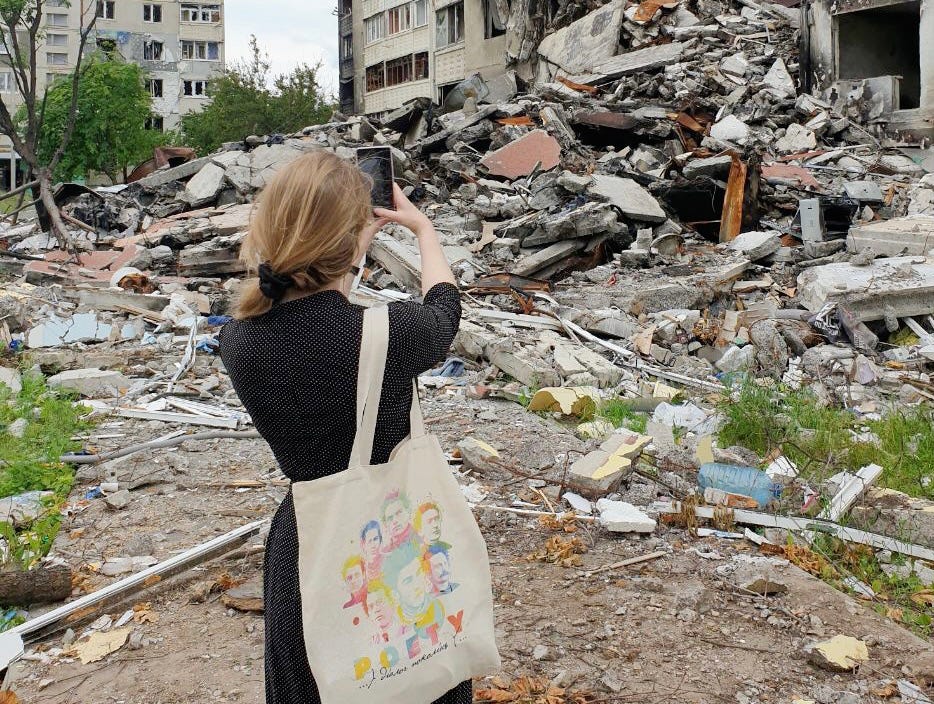
MJ: That’s absolutely heartbreaking. I can’t express how hard it is to hear these things when the rest of the world seems to go on as normal. It’s shocking, it’s absolutely shocking. Your Twitter posts help bring this home. In one, there’s a photo of you in front of a bombed-out building [see above], and the caption reads: It’s me in this picture, I’m a Ukrainian writer, I have portraits of great Ukrainian poets on my bag. I look like I should be taking picture of books, arts and my little son, but I document war crimes, and listen to the sound of shelling, not poems, why?” I think that’s extremely powerful, because it brings into immediate relief that this is happening in European cities that just recently were as peaceful as Paris or Prague, and now their residents have bombs raining down on them.
VA: That picture is from Kharkiv. There’s a great paradox here. In Kharkiv they have resumed having concerts, of course, in some underground bars and the like. My first trip to Kharkiv this summer was in the beginning of June. I traveled with PEN Ukraine, whom I’ve worked with for years, and we had a discussion with about seven writers, including Serhiy Zhadan, that was broadcasted online, about the war and how we’ve reacted as writers. It was important for us to have this intellectual debate in Kharkiv, to show that the city is not just a ruin.
MJ: I saw your Twitter post from last night, a video of people dancing in Kyiv, which was really beautiful, I thought. The caption reads: These people have just survived the most horrible six months of their lives, please stay with us through the winter. I was wondering if you could describe what that feeling was like when you were watching them dancing… their perseverance, their joy [see below].
VA: I actually had tears in my eyes when I saw those people dancing. I only managed to film the end of it. But I was so happy. I captured this moment because I decided to take a walk to the city center, to Maidan, the main square, and there were so many people there. Kids were climbing destroyed Russian tanks. There are signs that say don’t climb then, because they can fall apart. But still everyone was climbing on them. I had the same feeling when I was at a concert in Kharkiv in early August. There were singers and poets and musicians performing their songs in an underground bar. Again, I had tears in my eyes. Because this is what’s important. Even when Kharkiv is being heavily shelled every night, still the people gather in the bar. It is very important to maintain a sense of not just surviving, but living.
MJ: You told me in an email exchange that although your family is safe in Poland, you’ve “resisted the idea of becoming a refugee yourself.” That sounds a lot like what you’re talking about in Kharkiv, in the bars, and living, not just surviving. I’m wondering if you could talk a bit about why you chose to stay?
VA: Well, first of all, it’s very important for the victory for people to stay here, because not only soldiers are necessary to win, but civilians as well. In March, I worked at a humanitarian-aid warehouse. When I say humanitarian aid, this also includes actually working with tactical medicine items for the Army or ordering ammunition. I spent March in Lviv, I didn’t flee Kyiv. Actually, it was the opposite. When the war started, I was traveling in Egypt. So I spent two days trying to get back to Ukraine as soon as possible. I got back to Ukraine on Feb. 26, so I missed the first two days of the war. I wanted to be as helpful as possible. And, of course, it is important for a writer to witness this war, and to write firsthand accounts of what’s been witnessed. I should also say that it is more difficult for everyone I know to stay outside of Ukraine, even if they don’t have a choice: For example, they have little kids and they have no one to leave the kids with. My mom and my aunt are taking care of my son and my little niece, but other women don’t have this opportunity, and have to take their kids to safety themselves.
Many I know are depressed because they can’t actively participate in the war and work for victory. This is what helps you feel better—just to do something, and feel helpful, feel useful. Seeing all the Russian atrocities on social media, on television, is very depressing. Especially for those who come from those areas, and who know very well those places, and who know their neighbors were killed. So it’s a very difficult choice for them to leave the country. It’s a privilege that, so far, I’ve managed to stay here and work. Though I understand that I also have to make a choice, because I haven’t seen my son for nearly half a year now. Many kids have come back. Actually, Kharkiv has many kids, and Kyiv is full of kids. But so far, I’m scared to bring my child back.
MJ: How old is he? My son is 10 years old.
VA: Mine is 11.
MJ: That’s a great age. Not really a little boy anymore, but he’s not really a teenager either.
VA: Yeah, there was a fun moment when we were heading to Poland. It was the second day of war, Feb. 25. My son said something about the war on the train, and a man sitting next to him asked, “How do you know these things? Where do you get your information?” My son is like, “Well, I’m reading BBC and CNN.” The stranger on the train was surprised, but this is what’s happening. It’s very important I think for the kids to have offline education as well, because I don’t know, kids like my son, if they don’t have offline activities, he will keep reading the news. The news about Ukraine is not exactly a thing for such a child to read.
MJ: We spent a lot of time this summer with my wife’s parents, my son’s grandparents, in Tokyo. My son’s grandfather lost his mother and his two siblings in World War II in the firebombing of Tokyo. So, here’s this man who lost everything, his mother and his siblings, and it’s just one generation away. I feel like people don’t understand how easily civilization can crumble and turn into barbarity. You walk around the city of Tokyo, and you think how beautiful it is, and how orderly it is, and how beautiful the art is. Yet when my son’s grandpa was a little boy, he lost his mother and his siblings to the biggest war in history. So, somehow, we got complacent, and didn’t understand how close this is, and how quickly it can happen.
VA: This was happening in Ukraine as well, by the way, because when we say that the war started in 2014, it’s not that only Westerners forgot about this war. Some people in Ukraine also tried to not notice that the war was happening in the Donetsk and Luhansk region for all those years. Perhaps this is a natural reaction, and people try to invent reasons why this can’t happen to them. But the fact is that this can happen to anyone anywhere. It’s very important to understand that and the role that Russian propaganda has played in this. Victory Day in Russia is one of the biggest celebrations. Putin turned it into a military celebration of their military strengths. But you see that this year they didn’t have a huge military parade, because they didn’t have enough military equipment left and they didn’t have planes to fly over Moscow as usual. Too many of them were destroyed or were needed on the battlefield. But that’s the first time—usually the military parade on Victory Day is more important than Christmas in Russia.
MJ: That reminds me of Garry Kasparov and his 2015 book about Putin’s threat to the West. The full title of the book is Winter Is Coming: Why Vladimir Putin and the Enemies of the Free World Must Be Stopped. I’ve interviewed Kasparov several times and he’s been screaming this for years, long before 2014 and the first Russian invasion of Ukraine. But few leaders listened. I just hope we can correct course and see the world more clearly now.
I’ll let you get going. I know you need to get back to your work. But I want to say how much I admire your ability to see the truth, and your bravery, and your insistence on telling the truth. I know that it means a great deal to me, and to so many people around the world—the fight that you and millions of Ukrainians are fighting. It reminds me of René Char, the French poet who became a leader of the Resistance and fought against the Nazis in occupied France. Like Char said, “No siege is absolute.” I have no doubt that when this war is over, the greatest poets in the world will be writing in Ukrainian. I really believe that.
VA: Thank you so much, Michael. Thank you.
MJ: Take care, and God bless you and your son and your family.
VA: Thank you.


That's a heavy conversation after learning that she is no longer with us. Growing up with a mother, and uncles who experienced the Nazi blitz, first-hand, while scurrying their neighbors into the bomb shelters under our bars in N. Ireland. It resonates with the comment of hearing the air raid sirens. That sound literally put people into catatonic states. To hear their only refuge is a corridor w/o windows. The story I'll never forget my mother sharing is the finding of a young girl still holding a doll, and her head about two feet away. War is really Hell, and hearing her speak to you unknowing of her inevitable fate is even more moving. Thanks Mike.
Has ukraine committed any crimes in this conflict? Beside escalating and calls for WW3