
Big Snow in Iowa
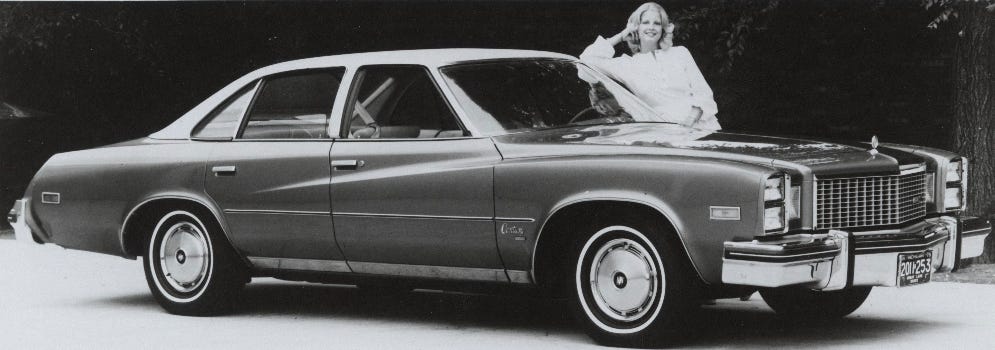
My brother Steve suffered from schizophrenia and died at 54. But a ride to school one snowy morning in his ’76 Buick Century made us feel like we'd live forever.

FROM THE ARCHIVES
With my home state of Iowa and much of the Midwest buried under a glistening blanket of snow, TFP revisits this short piece, first published by The Wall Street Journal in 2009, about my oldest brother Steve — still, all these years later, my greatest hero. — MJ
Big Snow in Iowa
My brother Steve suffered from schizophrenia and died at 54. But a ride to school one snowy morning in his ’76 Buick Century made us feel like we’d live forever.
By Michael Judge
IOWA CITY, Iowa — Like much of the Midwest, we got hit with a big snow at the start of this week—six inches of icy flakes that sent cars sliding into ditches and kids running for their sleds.
Winter storms like this always remind me of my childhood in Northern Iowa: bumper-skiing with Herman Berding and Timmy Naylon, throwing snowballs at pickup trucks, running for our lives.
Most of all they remind me of rides to school with my oldest brother Steve—short, terrifying journeys in what he liked to call his “Bicentennial Edition” Buick Century. With a 350 V8 under the hood, Steve’s ’76 Century was all Detroit—pomegranate red with an ultra-wide body that ran nearly the length of our driveway.
But I'm getting ahead of myself.
Steve died in 2013 at the age of 54—the same age I am now. That was a pretty good run considering he had suffered from schizophrenia since he was 21. According to numerous studies, people with schizophrenia have a greatly diminished life span.
How greatly? In general, they die more than 25 years younger than the general population. Why? The simple reason is it’s hard to live with schizophrenia. Depression, suicide, cardiovascular disease, cancer, diabetes—they often hit people suffering from schizophrenia earlier and harder.
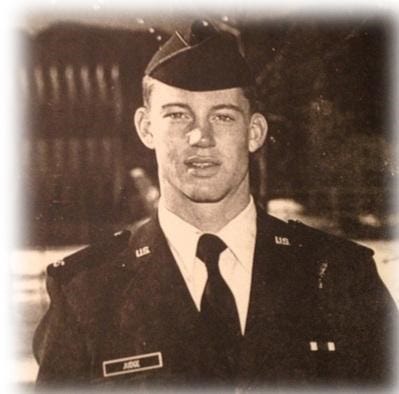
Steve was diagnosed with schizophrenia in the late 1970s. But after more than a decade of suffering in psych wards, he finally got on a medication that helped and hadn’t been hospitalized for nearly two decades when he died of heart disease a little over eight years ago. A new generation of antipsychotic medications called “atypicals” (Steve took Clozaril twice a day) calmed his mind and gave him his life back. His gentle nature and kindness was, in a very real sense, a gift to us all.
There was a time, however, when I would do just about anything to avoid being seen with Steve. In the summer of 1979, he was a dashing, third-year cadet in the Air Force Academy when an airborne insect—the irony is almost comical—sent him into a downward spiral of dementia and psychosis. While jumping out of C-130s in Arkansas, Steve was bitten by an encephalitic mosquito. Exactly when or where the bite took place we'll never know. Did the mosquito strike as he floated through the air, his chute billowing above? Or did he swat at it after landing, only later noticing a patch of blood on the side of his neck?
What’s certain is that the ensuing brain inflammation sent him into a weeks-long catatonic state, and eventually triggered another brain disorder: schizophrenia. He began accusing his doctors and family members of being "imposters." He was sure that I, his youngest brother, was "stealing his body," and there was nothing any of us could do to change his mind.
Despite the ineffectiveness of his medications, Steve returned home and tried to recreate the role of big brother he once played so effortlessly. The first thing he did was buy his '76 Century, and he cared for it as if it were his last link to the real world, the one where people wake up and go to work and little brothers are dropped off at school.
Of course, the last thing I wanted was to have my schizophrenic brother drive me to high school, but sometimes there just wasn't any alternative. Back then Steve didn't drive in the calm and courteous manner he developed later in life. Every stop and start was handled in the same way: a screeching of tires that flung you forward, followed by an abrupt acceleration that popped your head back like a Pez candy dispenser.
One particular morning, however, there was no screeching of tires. It was bitterly cold, a few days after a winter storm, and the streets that led to my high school were lost under layers of ice and snow.
Somehow we managed to fishtail our way to the school grounds, the Buick's bald tires spinning furiously at every start and turn. Unfortunately, the quarter-mile drive that ran to my high school ended in a roundabout that was difficult to navigate, even under the best of conditions by the healthiest of drivers.
Undaunted, Steve gunned it. As we approached the roundabout it was clear to us both we'd never make the hairpin turn looming ahead. Thus it was that Steve slammed on the brakes, locking up the wheels of his cherished Buick Century and sending us gliding toward a two-story mountain of shoveled, parking-lot snow.
“Hold on,” Steve said.
I did as I was told and braced for an impact I was sure would be a violent one. To my amazement, the Buick's mighty hood didn't buckle when it struck the mountain of snow but instead rose, like some great steel sleigh, toward its peak. As we climbed I pictured us soaring above the parking lot before landing on some misfortunate cheerleader's Datsun B210.
Miraculously, we never did become airborne. Instead, our momentum carried us to the very pinnacle of the snow mountain where we teetered, the Buick's front wheels spinning wildly, before coming to a complete stop.
It was then that Steve turned toward me, our eyes meeting for what seemed the first time in years, and we began to laugh.
Our laughter filled the mammoth front seat of his Bicentennial Edition Buick Century and poured out into the parking lot; it traveled back the entire course of our harrowing journey and beyond before giving way, somewhere in the frozen air above Iowa, to silence.

For more information on schizophrenia, bipolar disorder, major depressive disorder, schizoaffective disorder, and other serious mental illnesses, please visit these sites:


TFP IS A PROUD MEMBER OF THE IOWA WRITERS COLLABORATIVE

A great story and one heck of an ending anecdote! Great image of the car spewing laughter
Damn. Just found this article of yours. I know it is sensitive for you probably, but did your brother's schizophrenia occur after the mosquito bite or was he diagnosed with that earlier?
The reason I am asking is because there is a suspicion I have (that probably some mental health experts share as well) that sometimes mental illness is actually a neuropsychiatric condition, that is: a central nervous system infection or encephalitis resulting in a "regional tissue damage" causing associative problems within the brain. Lyme Neuroborreliosis (LNB) is one such condition, but by now we have a many case studies of specific viruses, spirochetes or even fungal infections causing encephalitis.
Now of course if the diagnosis occurred before the mosquito bite, my comment is just a waste of space, but thought I would still ask. It is worth noting that in some LNB cases antibotics treatment worked better than mood regulators...